

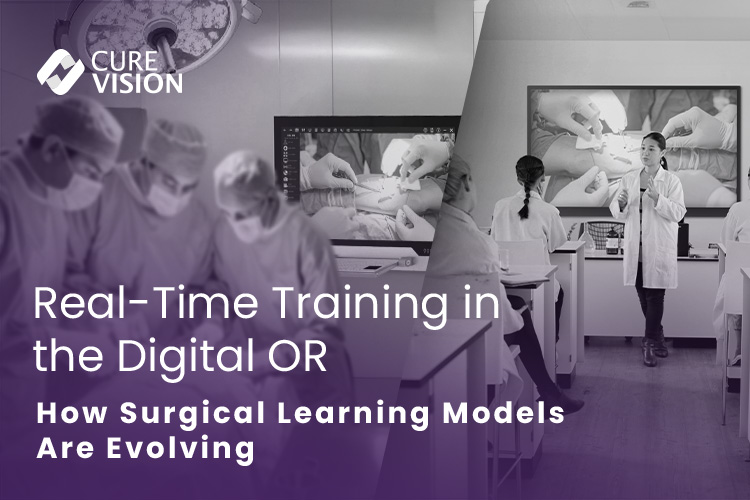
Real-Time Training in the Digital OR / How Surgical Learning Models Are Evolving
Introduction: The Rise of Real-Time Surgical Training in the Digital OR
Traditional surgical training has a structural problem: the OR is a small, sterile, high-stakes environment — and it was never designed for education. Restricted viewing angles, crowded spaces, and inconsistent case exposure have limited what residents and students can realistically learn during live procedures.
OR integration systems are removing these constraints. By centralizing video sources, enabling telepresence, and automating case documentation, digital OR platforms are making surgical training more accessible, more structured, and fundamentally more effective — without changing what happens on the table.
Why Traditional Surgical Training Can't Scale — And What's Replacing It
For decades, surgical education relied heavily on physical presence in the OR. However, this model comes with several limitations:
- Restricted viewing angles limit understanding of anatomy and technique.
- Crowded OR environments reduce educational access and create workflow challenges.
- Inconsistent exposure to rare cases slows skill development.
- Delayed explanations cause trainees to miss critical decision moments.
These challenges highlight why modern programs are increasingly turning to digital OR technologies to support real-time surgical learning.
How Digital OR Integration Systems Enable Real-Time Surgical Education
1. Multi-Source High-Resolution Imaging
The digital OR integrates multiple live video sources—endoscopic cameras, surgical microscopes, overhead cameras—into a unified platform.
Why it matters:
Trainees can see detailed anatomy and surgeon maneuvers from multiple angles, improving comprehension and reducing ambiguity.
2. Telepresence for Remote Surgical Observation
Telepresence allows medical students and residents to join live procedures remotely, with synchronized audio and video in real time.
Benefits:
- Access to complex cases regardless of location
- Scalable education without crowding the OR
- Safer observation without entering the sterile field

3. Real-Time Annotation and Guided Explanation
Digital OR platforms enable instructors to draw, highlight or mark critical structures during live surgery.
Outcome:
Trainees receive immediate, context-rich explanations that deepen understanding compared to post-op review alone.
4. Automated Recording and Case Documentation
Modern OR integration systems capture full-length procedures, snapshots and key events automatically.
Why it’s valuable:
Recorded cases become reusable educational resources, allowing trainees to revisit techniques and evaluate surgical decision-making.
How Surgical Training Models Are Changing With Digital OR Technology
A Shift from Passive to Interactive Learning : Real-time digital tools encourage questions, dialogue and step-by-step guidance without disrupting the surgical flow.
Scalable Access Across Institutions : Telepresence eliminates physical limits—multiple groups across different locations can join the same case simultaneously.
Structured, Data-Driven Skill Development : With annotated recordings and indexed case libraries, educational programs can build consistent, competency-focused training paths.
Enhanced Visualization for Better Skill Acquisition : High-fidelity imaging provides clarity that textbooks, diagrams or in-person observation alone cannot match.
Medical Students and Residents Gain From Digital OR Training
- More predictable and consistent access to surgical cases
- Improved understanding of anatomy, instrument handling and technique
- Faster transition from observation to hands-on learning
- Safer educational environment with minimal OR disruption
- Greater equity in training across institutions and regions
These advantages underscore why real-time digital training is becoming a core expectation in modern surgical education.
Digital OR Technologies Are Shaping the Future of Surgical Training
The integration of telepresence, multi-source imaging and automated documentation is redefining how surgical trainees learn in real time. These innovations make education more accessible, more interactive and far more aligned with the pace of modern surgery.
As healthcare continues to adopt digital OR platforms, real-time surgical training is poised to become the global standard—bringing clarity, consistency and scalability to the next generation of surgeons.
How CureVision Supports Surgical Education in the OR
CureVision's OR integration systems include multi-source video routing, real-time annotation capabilities, telepresence via CURELINK, and automated procedure recording — the technical infrastructure that makes real-time surgical training possible.
Hospitals using CureVision's integrated OR platform gain not just a surgical control system, but an educational infrastructure that supports residents, students, and remote specialists simultaneously — without disrupting the sterile field or surgical workflow.